Background
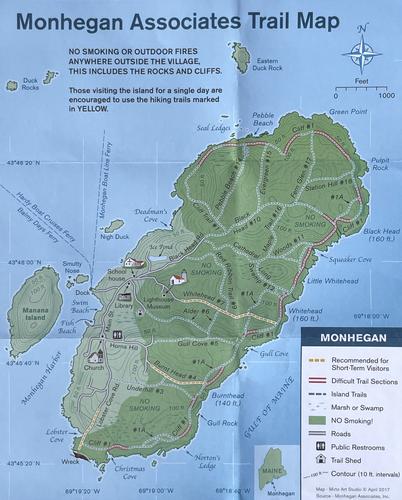
I spent the summer of 2025 working as a gardener for a hotel on Monhegan Island in the gulf of Maine. One of the many highlights of working here is the access to miles of hiking trails that meander across bogs, beaches, old growth forests, and seaside cliffs towering over the Atlantic Ocean. The whole island is only a little over 1 square mile, so by the end of the summer I had been back and forth across every marked every trail, some unmarked trails, and scrambled up and down a couple cliffs. It was out on these hikes that I took an interest in the lichen that was growing on the rocks.
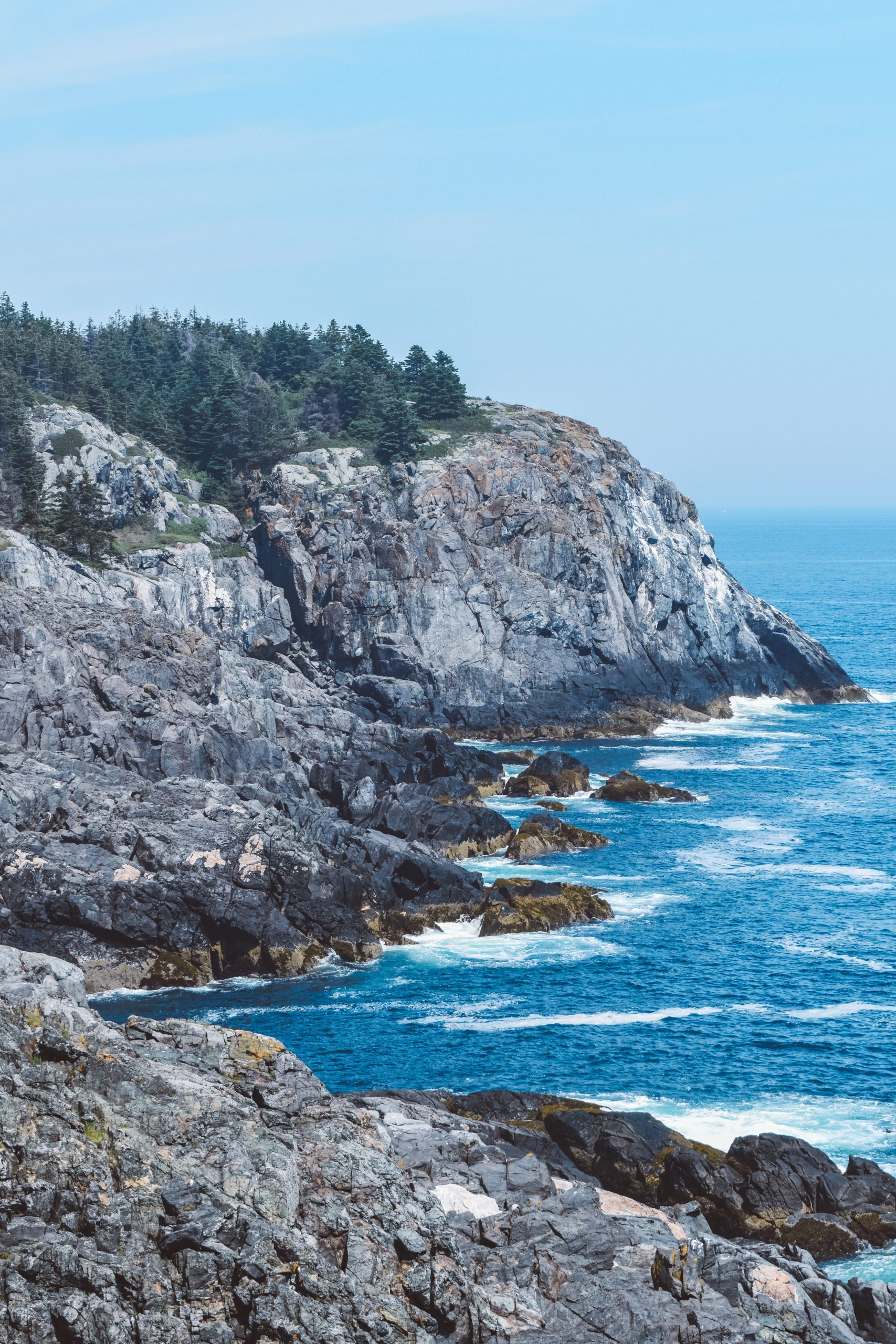
What is Lichen?
Here is a brief description from the U.S. Dept. of Agriculture:
“Lichens are a complex life form that is a symbiotic partnership of two separate organisms, a fungus and an alga. The dominant partner is the fungus, which gives the lichen the majority of its characteristics, from its thallus shape to its fruiting bodies. The alga can be either a green alga or a blue-green alga, otherwise known as cyanobacteria. Many lichens will have both types of algae.”
https://www.fs.usda.gov/wildflowers/beauty/lichens/about.shtml
Finding Inspiration in the Rocks and Dirt
In spring of 2025, a large portion of my graduate exhibition was made up of small color field painting with no discernable references. I was really interested in mid-century color field painters such as Helen Frankenthaler and Lynne Drexler, and wanted to create similarly abstracted works that focused solely on color, composition, and balance. I prefer to work on bigger surfaces, but I found that as I scaled up the size of these paintings the lack of a reference made them feel vapid. I was able to combat this by finding references in nature that were two-dimensional and featured interesting color variations, such as water surfaces, rock faces, and tree bark.
The largest color field painting I created was Composition #1: Mossy Stone (Grey), a 30” x 30” painting that is based on lichen I saw while hiking in Kisatchie National Forest. When I made this painting, I viewed it as a generic color field that used the lichen as a foundation for the colors and composition, rather than a painting of the lichen itself. By starting with a completely flat two-toned background, and sticking strictly to horizontal and vertical square brushstrokes, I was able to flatten the picture plane and successfully strip away the representational elements of the reference photo. It ended up being one of my favorite pieces in my exhibition.
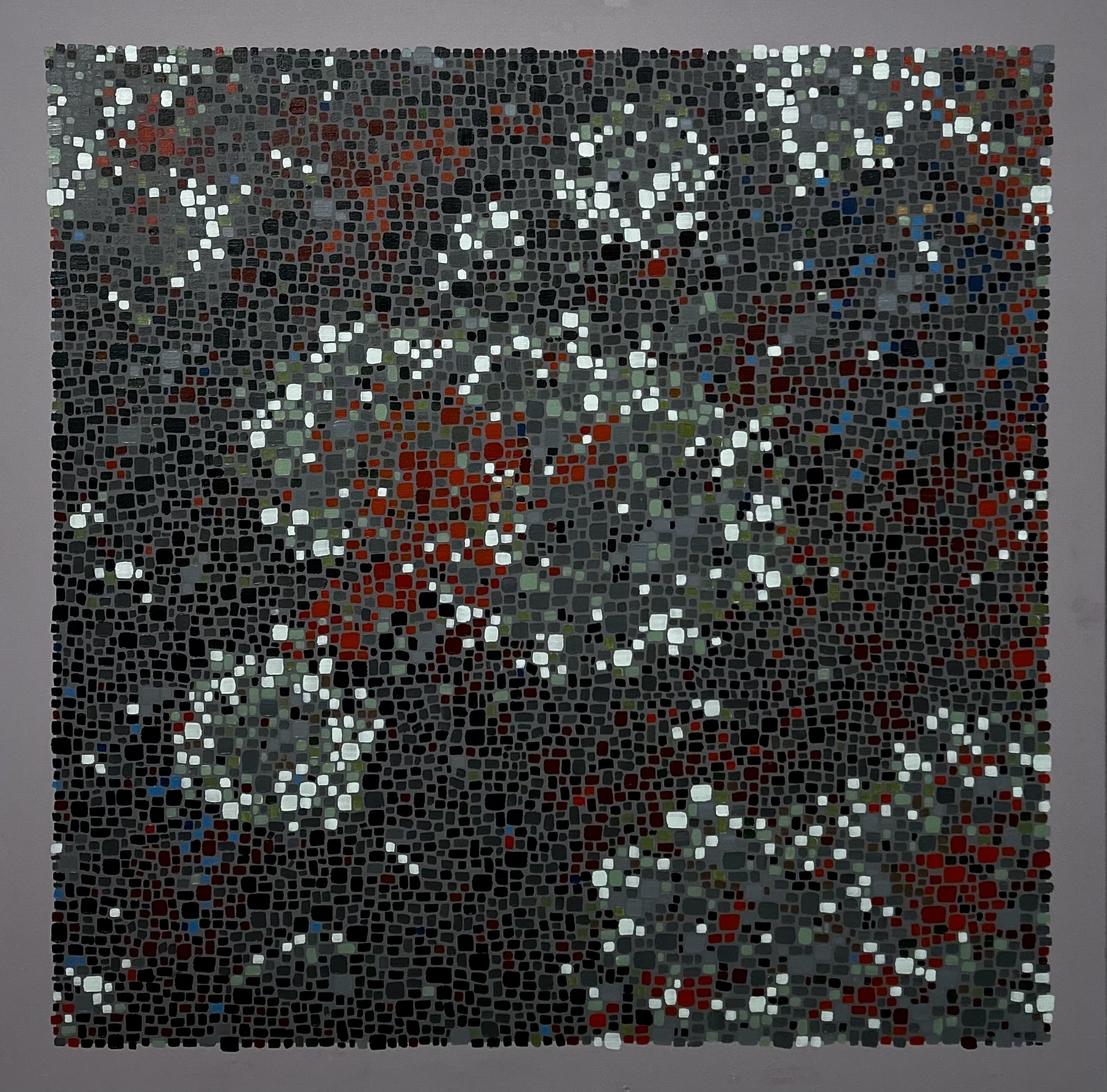
Composition #1: Mossy Stone (Grey), 2025, Acrylic Paint on Canvas, 30″ x 30″
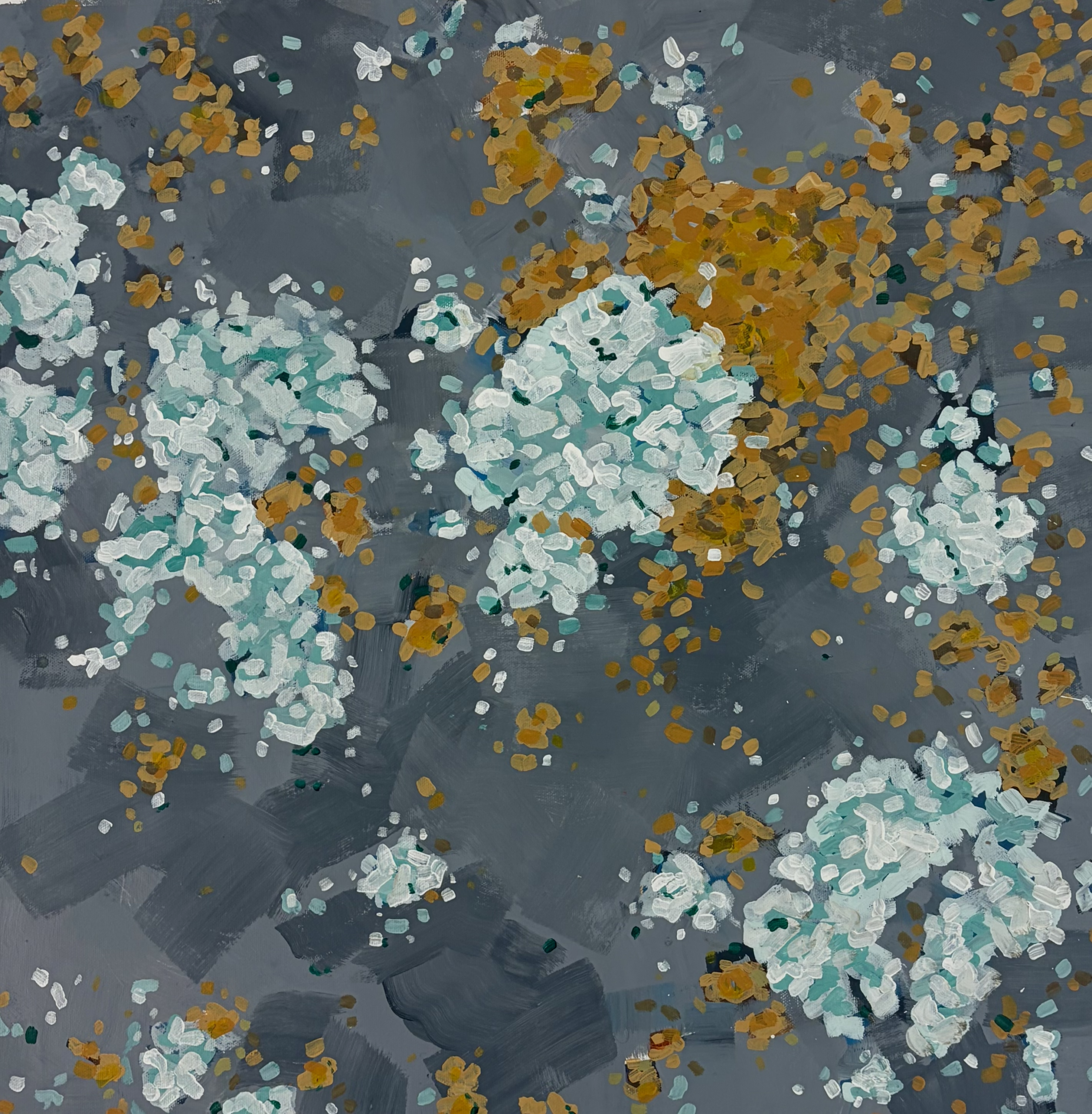
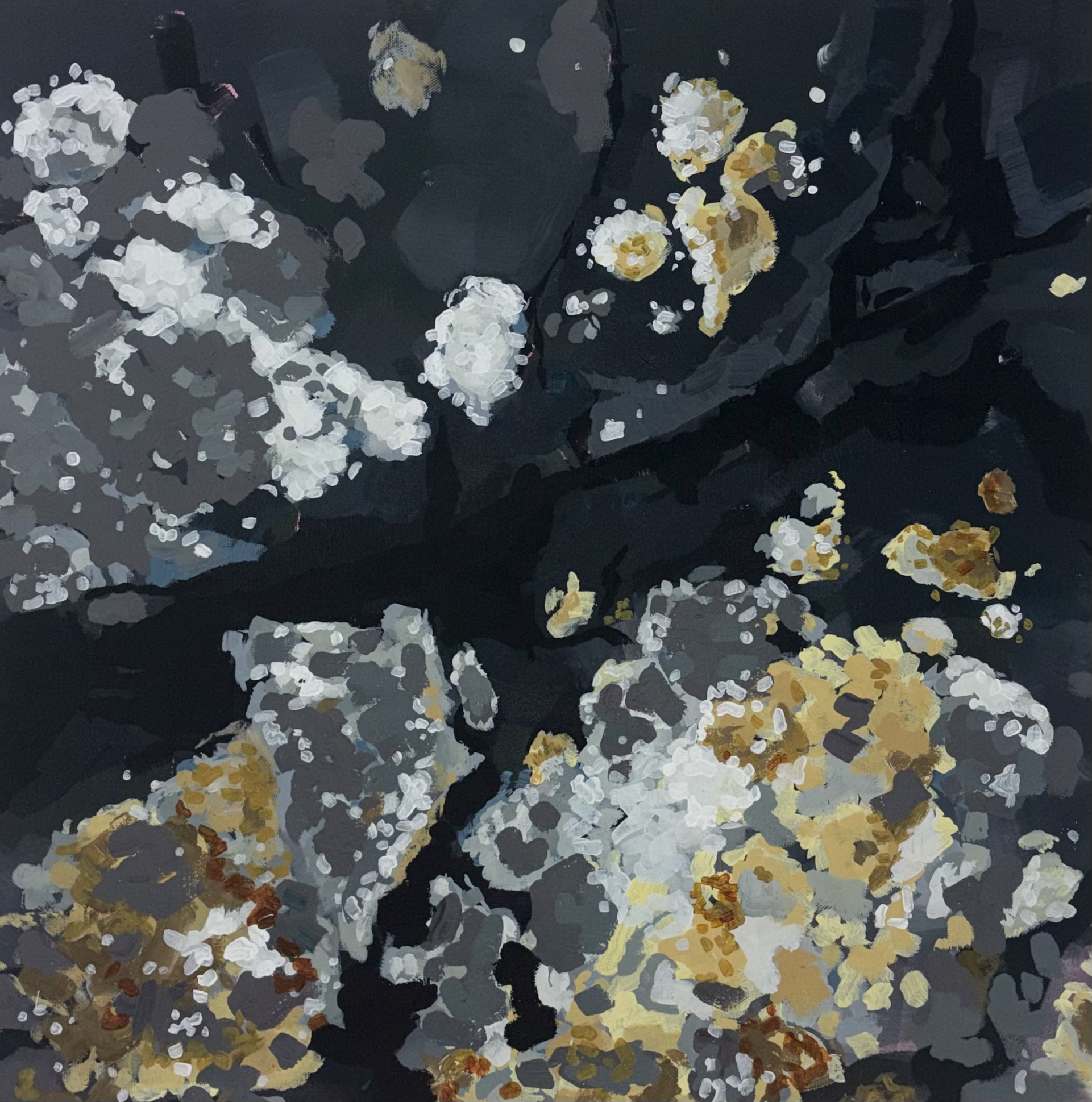
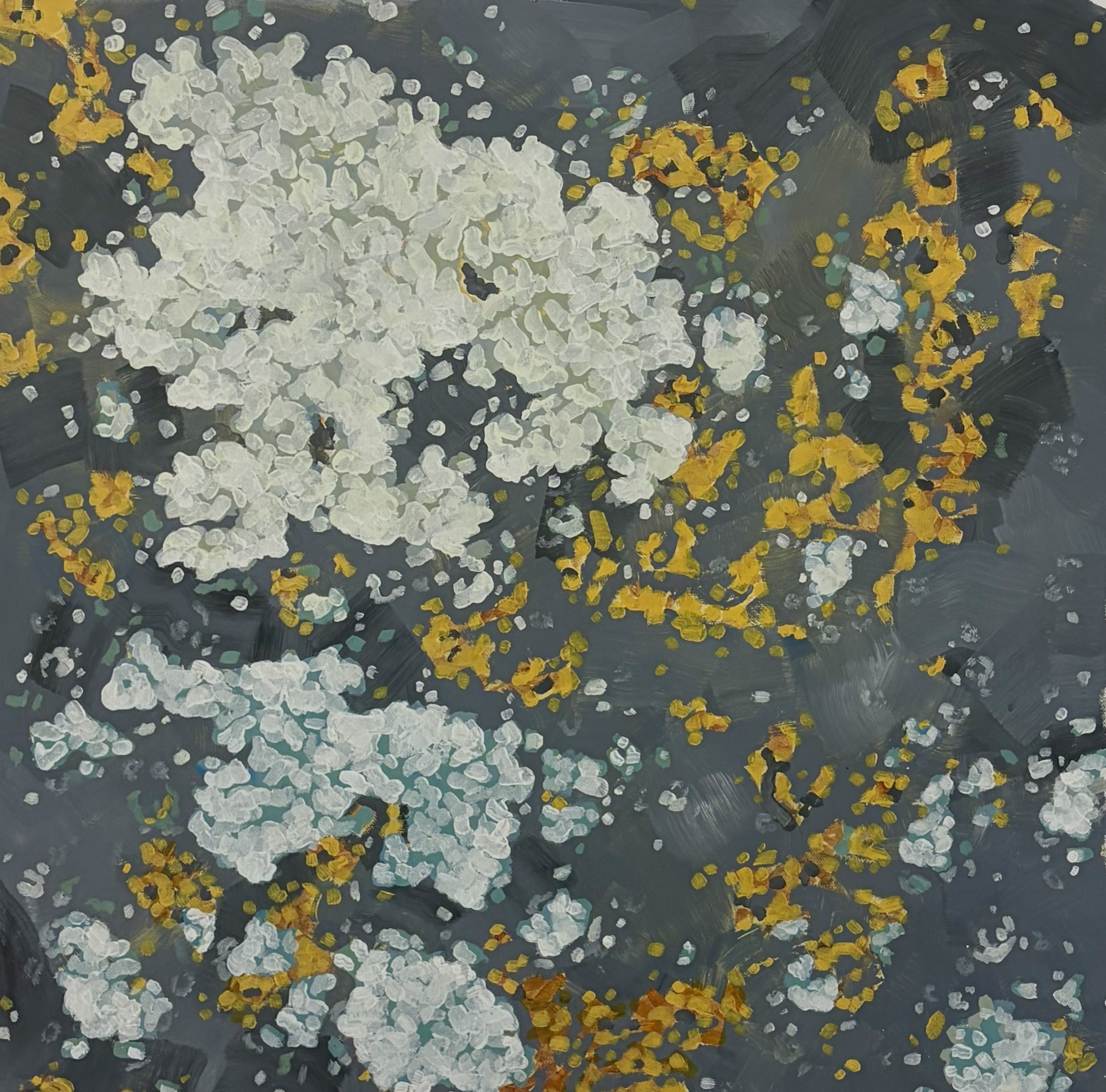
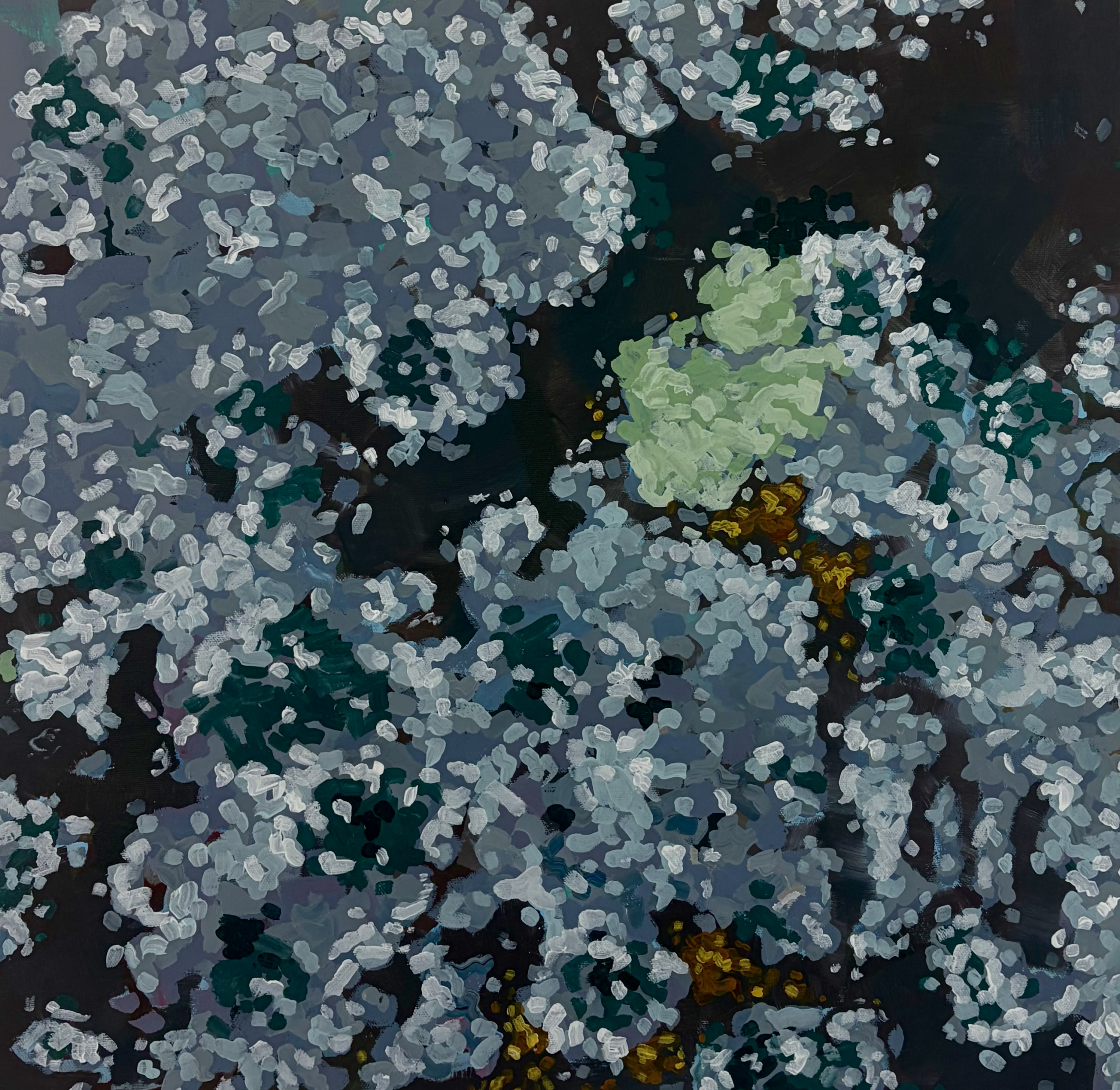
There were many interesting lichen formations on Monhegan, so I wanted to keep exploring it as a reference. Rather than repeat the concept of the aforementioned painting, I took a less formulaic approach, worked more directly off of reference photos, and aimed to create a sense of depth that I had avoided in my previous work. This is what resulted in the series of lichen paintings that I made this last summer.
Lichen Paintings Summer ’25
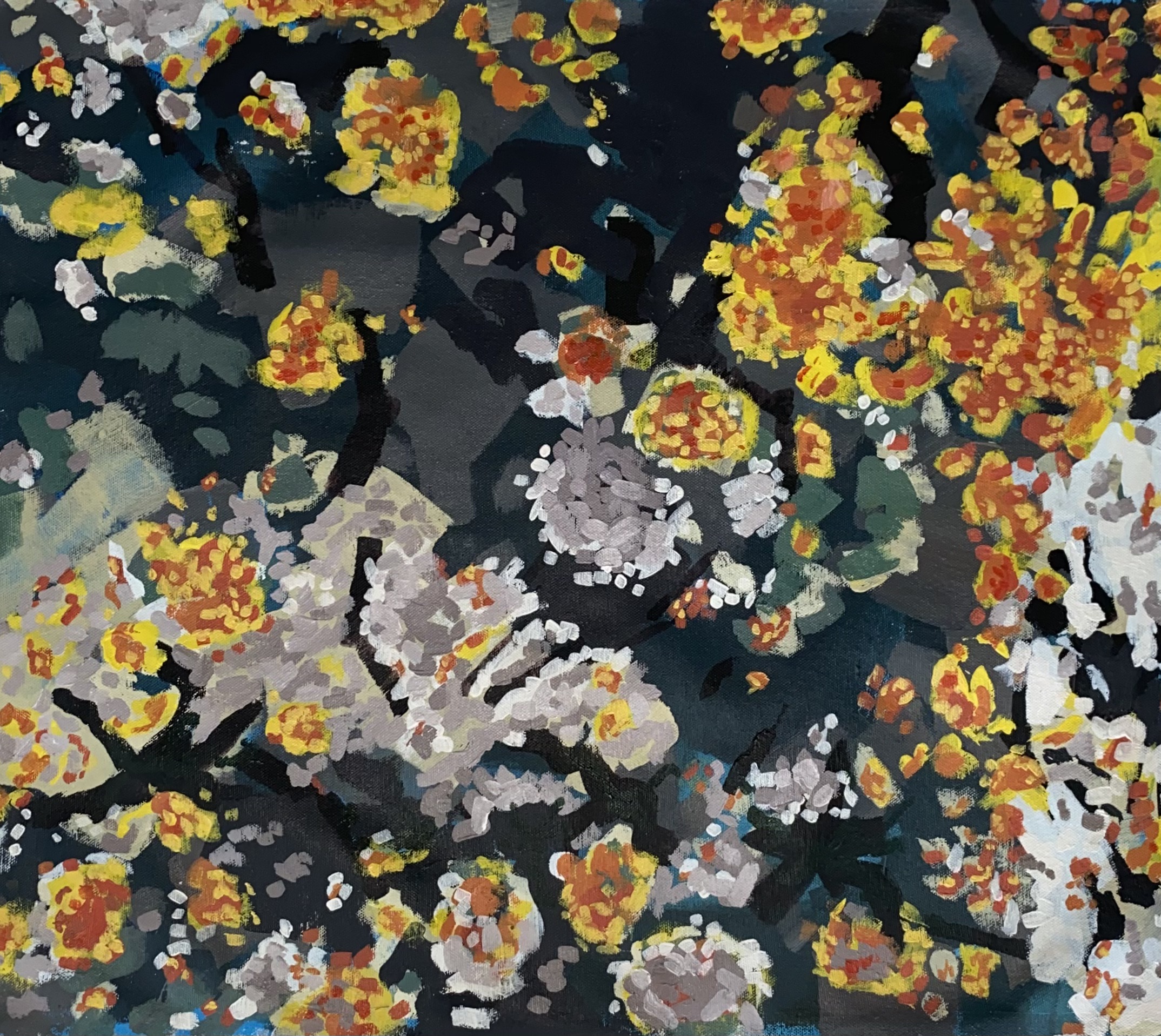
The first of this series is Sunburst Lichen Facing East, which is based on a reference photo I took of Xanthoria parietina, commonly known as maritime sunburst lichen, growing near Gull Rock. Of my lichen paintings, this one has the most expressive brushwork and really emphasizes contrast in both color and value, with bright, warm patches of color sitting on top of a dark, cool toned background. I developed the general methodology of establishing a few large blocks of neutral colors as the foundation, then building up layers of overlapping marks to create the organic shapes of the lichen formation. I liked this painting overall, but I found it to be a bit busier and more expressive than what I was aiming for.
I don’t have a great picture of it because I sold it to a dentist that was staying at the hotel (good for me!), but I will include an in-progress picture I took.
In the paintings that followed, I toned down the color pallet and was more intentional with where I placed areas of high contrast. In doing so, I was able to create balanced compositions with distinct focal points based on the organic shapes and colors in my references. I find that these do a better job of toeing the line between representation and abstraction.
Other Artists Exploring Lichen
As you can imagine, I’m not the only person to have my eye caught by the funky shapes and colors that lichen form on natural surfaces. Here are a couple other artists that have been inspired by these little life forms.
Karin Daymond
Karin Daymond is a South African based landscape painter that has an ongoing series of lichen paintings. I absolutely love the way she centers the forms on her canvas and uses color, especially white accents, to emphasize the radial nature of lichen’s growth.
Lara Call Gastinger
Lara Call Gastinger is a botanical artist who has dabbled in painting lichen. I found out about her from Alyssa Gregory’s blog post “looking at Lichen through 500 years of Botanical Art” on the Bell Museum’s website. She has an amazing piece where she painted Moonglow Lichen on a piece of calfskin vellum.
Robert Thompson
Robert Thompson is a natural history photographer, author & conservationist that specializes in close-up and macro photography. His photos of lichen are often closely cropped to the point that they look like abstract paintings.
Leave a Reply